The River Continuum Concept
A Defining Moment in Stream Ecology
In the late spring of 1974, many of the country’s best freshwater scientists gathered at Stroud Water Research Center, then a field station of the Academy of Natural Sciences of Philadelphia, for a multiday symposium on stream ecology and future scientific collaboration.
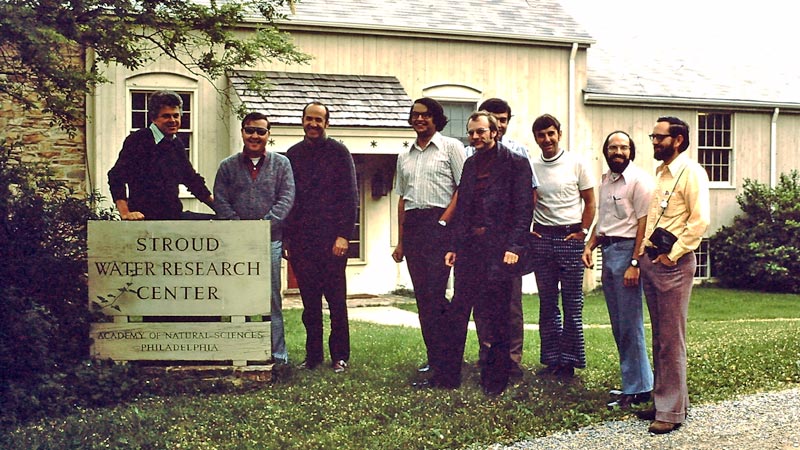
The meeting, the second of four held around the country, included participants from Oregon State University, Idaho State University, Michigan State University and the Stroud Center, which at the time were the four principal hubs of stream and river research in North America.
In the wake of the 1972 Clean Water Act, the National Science Foundation (NSF) had challenged the group to come up with ideas to address the nation’s growing concern about the condition of its fresh water.
The talk was lively, and the ideas bandied about were interesting, remembered Robin Vannote, then the director of the seven-year-old Stroud Center. But the discussion mostly involved ideas for expanding the kinds of research the scientists were already doing. Vannote had grown impatient with such incremental steps forward. These were important, to be sure, but it seemed time for something bigger.
What we need now, he thought, is an overarching idea that will not only make sense of the enormous amounts of data we have painstakingly collected, classified, and catalogued in countless streams but will also provide a grand hypothesis that will push the scientists and their research into uncharted waters — we need to understand how all the pieces fit together into a single whole.
So Vannote suggested they step back from the data and think of the stream itself as an organism. As he talked, he drew for his audience a verbal portrait of a river as a single interconnected system, one that begins as a tiny channel and grows larger as it moves downstream.
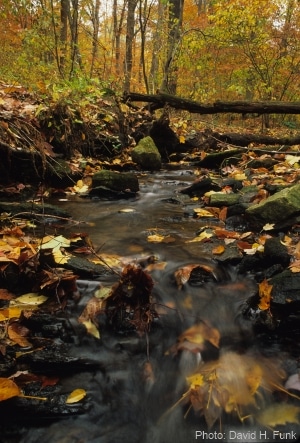
As it joins with other streams and swells with groundwater, its channels widen and deepen until, now a large river, it flows into the ocean. What distinguishes such a system from other bodies of water, he said, is that it is continuously moving. Each part of a stream — each riffle and pool — is affected by what is happening not only immediately around it, but also upstream and downstream from it. As it flows, a stream’s physical characteristics change to keep it from overwhelming its channel, and its biological communities must adapt to those changes.
It’s all connected, he concluded, from its headwaters to its mouth, and to really understand how a river system works, we must see it as a physical and biological continuum, striving to maintain its equilibrium in the face of constant change.
There followed, after he had finished, a moment of stunned silence. “Everyone was bowled over,” remembered a young microbiologist named Tom Bott. “It was so simple, so elegant.” It was what Thomas Kuhn, in The Structure of Scientific Revolutions, called a “paradigm shift,” in this case, a profound change in understanding the nature of rivers, after which no one would ever again think about them in quite the same way.
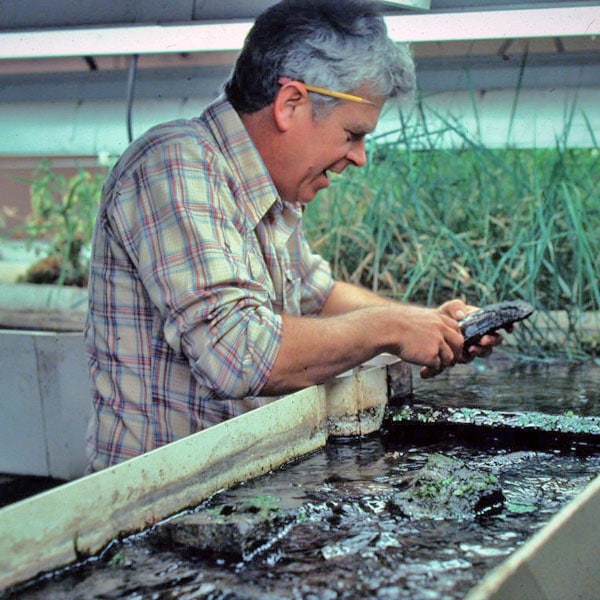
“From headwaters to mouth, [we] reason that producer and consumer communities characteristic of a given river reach become established in harmony with the dynamic physical conditions of the channel.”
— ROBIN VANNOTE , Ph.D., THE RIVER CONTINUUM CONCEPT (1980)
“We need to take this idea to Washington [DC] immediately,” said Jim Sedell from Oregon State. And so they traveled to the NSF to seek a grant that would enable them to test the theory in streams across the country.
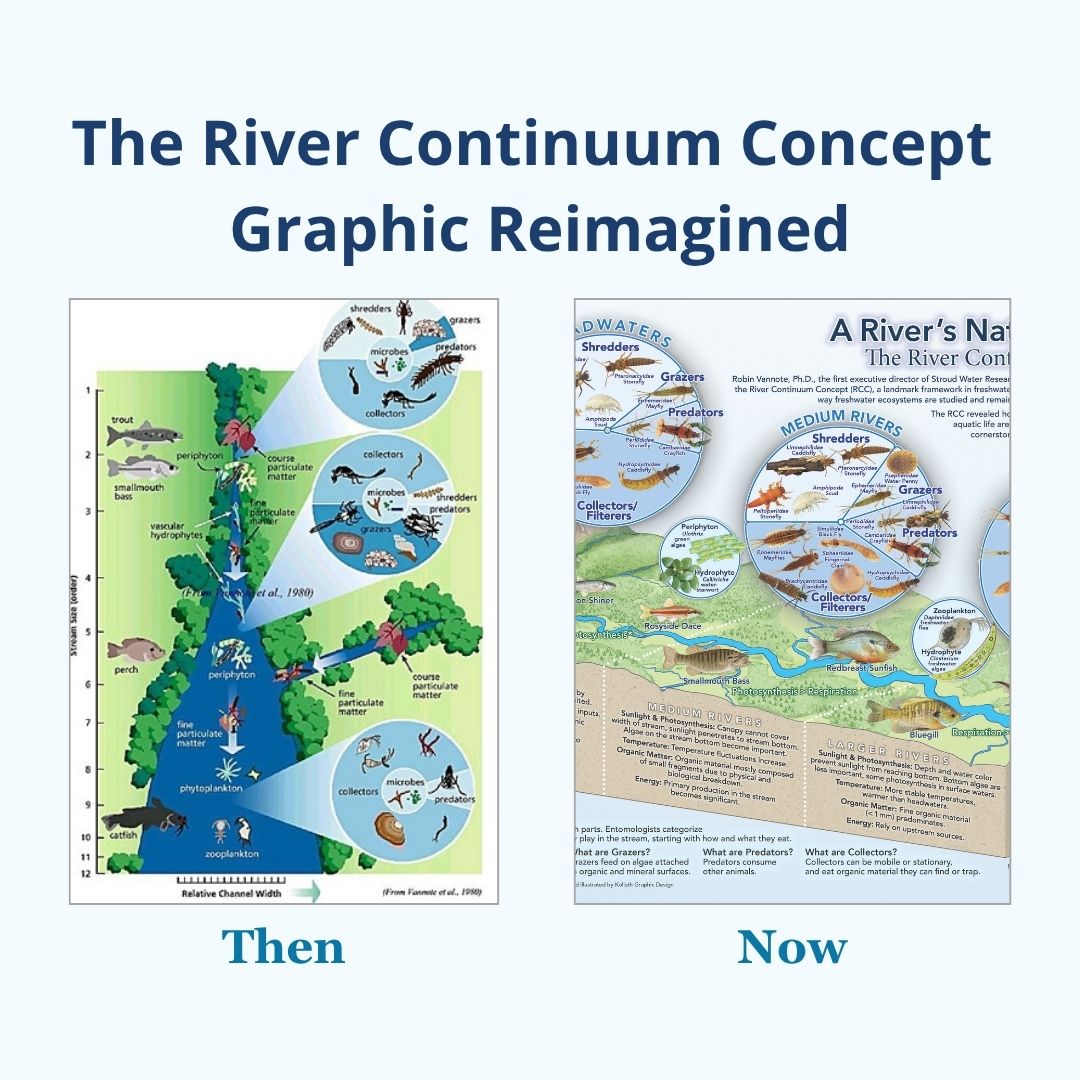
What Vannote had described is now known as the River Continuum Concept. It was the first unified hypothesis about how streams and rivers work, and 43 years later, its influence persists. It has been cited over 8,000 times in peer-reviewed journals — more often than any other paper in the history of freshwater science.
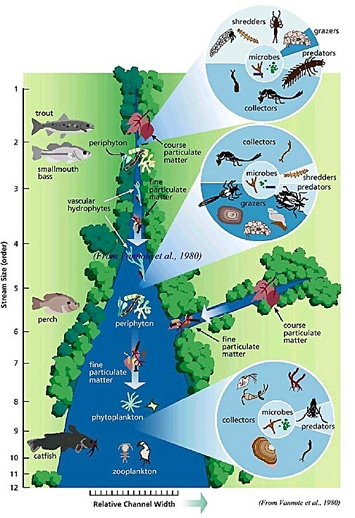
While the research that led to it was rigorous, painstaking, and complex, its message is remarkably simple: beneath the apparent chaos of a stream’s ecosystem, where billions of creatures live and die seemingly at random, there exists an underlying order in which all the organisms are connected to one another.
Therefore, Vannote deduced, in what was his key insight, you should be able to look at what was happening in any particular section — or reach — of a stream and make predictions about what was simultaneously happening upstream and downstream from it.
This meant, among other things, that you could determine the impact of human activities — their farming practices, their industrial sites, their sewage treatment plants, their commercial and residential developments — on downstream waters.
And if you could do that, you could also suggest changes to those activities that would protect the quality of the water and the health of all who depend on it.
The River Continuum Concept was built on prodigious research into all aspects of streams and rivers. But when all the data had been analyzed and all the scientific studies read, it required something else: a leap of the imagination that transcends science.
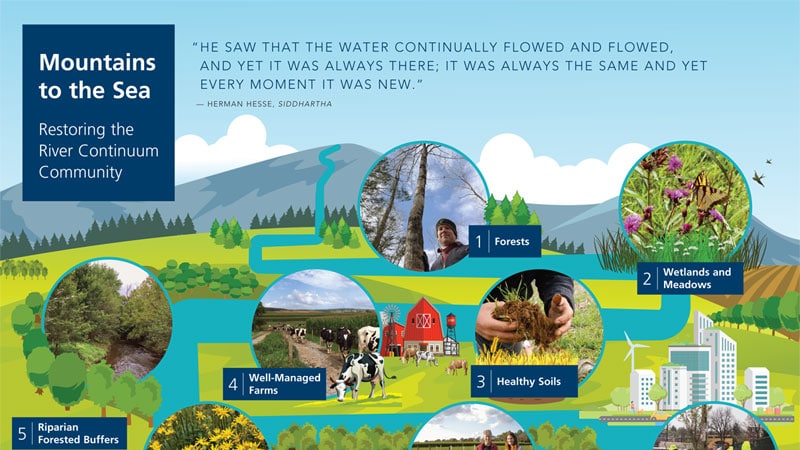
Vannote’s description of a dynamic harmony, in which predictable stability stems from unpredictable change, seems not unlike what Siddhartha noticed in Hermann Hesse’s 1922 novella: “But today he only saw one of the river’s secrets, one that gripped his soul. He saw that the water continually flowed and flowed, and yet it was always there; it was always the same and yet every moment it was new.”
The River Continuum Concept did not, of course, spring fully formed from Vannote’s brain that afternoon in 1974. It had its origins in his past work on the Red Cedar and Tennessee rivers; it built on the contributions of many of the scientists who were gathered around the table in the Stroud Center’s library; it owed much to Ruth Patrick’s decades-long explorations of the web of life in Conestoga Creek in nearby Lancaster County, Pennsylvania, and to the work of Luna Leopold and others on the physical characteristics of river systems.
Subscribe to Freshwater E-News
Sign up for our monthly UpStream Newsletter, and we’ll send you a link to download a hi-res PDF of our River Continuum Concept poster!