Federal protections for clean water in the United States hinge on a question the Supreme Court explored in 2023 in Sackett v. EPA: Which waters count as Waters of the United States (WOTUS)? The answer determines which streams, wetlands, and other surface waters are protected by the Clean Water Act.
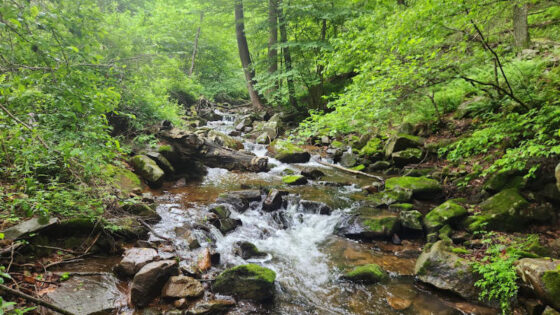
A new proposed rule would narrow the WOTUS definition, potentially removing protections from many streams and wetlands, especially those that emerge only seasonally or after rain. We often find these waters in our communities, filtering pollution, reducing flooding, and sustaining life in our rivers.
They may be small or temporary (and may therefore seem insignificant), but research shows they matter a great deal, and not just locally: They connect to downstream waters, contribute the most water to U.S. rivers, and impact drinking-water supplies and ecosystems.
At Stroud Water Research Center, we are committed to ensuring that policies like this are guided by science. For nearly six decades, our researchers have studied how freshwater systems function as connected networks, and we continue to bring that expertise to policymakers to support effective, science-based protections.
Below, we share the comments we submitted on the proposed WOTUS rule, along with key scientific insights to help protect our nation’s waters.
2 January 2026
Honorable Lee Zeldin
Administrator
U.S. Environmental Protection Agency
Honorable Adam Telle
Assistant Secretary of the Army (Civil Works)
Department of the Army
Re: Docket ID No. EPA–HQ–OW–2025–0322 — Updated Definition of “Waters of the United States” (Proposed Rule)
Dear Administrator Zeldin and Assistant Secretary Telle:
Stroud Water Research Center is pleased to offer comments on the proposed rule titled Updated Definition of ‘Waters of the United States,’ published November 20, 2025. Stroud Center scientists are internationally recognized technical experts in the hydrology, chemistry, and biology of fresh water. Since 1967, we have advanced freshwater science through field and laboratory research that has produced foundational discoveries and innovations serving the nation’s environmental interests.
Public polls show that 72% of the U.S. public supports restoring federal protections of wetlands and streams to pre-rollback levels, and 96% of voters believe protecting water in lakes, streams, and rivers is important (Walton Family Foundation, 2022). Yet the proposed WOTUS rule further weakens these protections. For the 24 states relying solely on the Clean Water Act, this creates a total regulatory vacuum, leaving those waters with little to no state or federal oversight (Sulliván et al., 2025).
As the primary regulatory mechanism for protecting aquatic biodiversity, water quality, and freshwater resources in our country, the definition of “waters of the United States” is crucial to Americans’ quality of life and water security. National monitoring continues to show that aquatic conditions are not improving across much of the United States, underscoring the need for approaches that effectively restore and maintain the integrity of the nation’s waters (USEPA, 2018–19).
Watersheds function as connected networks. Ephemeral and intermittent channels and wetlands — while not continuously flowing — can contribute substantial volumes of water and associated materials to downstream rivers. Recent national-scale analysis estimates ephemeral streams contribute, on average, a majority share of discharge exported from regional river systems (Brinkerhoff et al., 2024). EPA’s scientific synthesis on connectivity similarly emphasizes that streams and wetlands influence downstream waters through physical, chemical, and biological pathways (USEPA, 2015). These findings are consistent with a systems view of watershed protection: upstream processes are prerequisites for downstream restoration (Ensign et al., 2024).
While we recognize the proposed rule’s stated goal of implementing Sackett v. EPA, the way key terms are defined will determine whether implementation is predictable, scientifically grounded, and protective of water quality.
Below, we provide recommendations and implementation guidance on the issues most relevant to the proposed rule’s revised and newly codified definitions.
(1) Relatively Permanent Waters
Observation
The proposed rule would define “relatively permanent” as “standing or continuously flowing bodies of surface water” that are “standing or continuously flowing year-round or at least during the wet season.” The preamble discusses multiple approaches to identifying “wet season” and asks whether a definition should be added to regulatory text.
From a hydrologic perspective, the most fundamental distinction between relatively permanent waters and ephemeral waters is groundwater influence — that is, whether the channel/basin interacts with the water table such that flow or standing water persists beyond immediate precipitation-driven runoff. This is a physically grounded concept that can be evaluated with field observations (timed to avoid stormflow) and supported by available groundwater monitoring information.
Recommendation
We recommend revising or supplementing the proposed “wet season” formulation so that “relatively permanent” is identified using hydrogeologic evidence of groundwater interaction, rather than relying primarily on climatological season definitions. If the agencies retain a “wet season” component, it should be (1) explicitly defined in regulatory text and (2) implemented as a supporting line of evidence — not the controlling test — because “wet season” varies greatly by region, year, and climate trend.
Implementation suggestions
- Field evaluations should occur when it is not raining (to avoid misclassifying stormflow as “relatively permanent”) and during periods when shallow groundwater is seasonally elevated (to avoid missing groundwater-sustained flow).
- Where “wet season” is retained, EPA or the Army Corps of Engineers should define it transparently and apply it consistently across regions, with clear documentation of data sources and averaging periods.
(2) Continuous Surface Connection
Observation
The proposed rule defines “continuous surface connection” as “having surface water at least during the wet season and abutting (i.e., touching) a jurisdictional water.” This definition introduces two implementation constraints: (1) a seasonal surface-water requirement and (2) an “abutting” requirement.
From a hydrologic standpoint, high-water and floodplain processes can create periods when there is effectively “no clear demarcation” between waters and adjacent wetlands because inundation can connect features across the landscape. Rigid “wet season” and “touching at baseline conditions” framing risks excluding wetlands that are demonstrably connected during high-water episodes — the very periods when transport of sediment, nutrients, contaminants, and organisms is most consequential.
Recommendation
We recommend that EPA or the Corps clarify that “abutting” can be satisfied during high-water conditions when inundation creates an unbroken surface-water pathway such that there is no clear demarcation between the jurisdictional water and the wetland. This approach aligns implementation with hydrologic reality while still operating within a surface-connection framework.
Implementation Suggestions
- Use inundation mapping and elevation benchmarks (e.g., established floodplain mapping and high-water indicators) as transparent tools to document when surface pathways occur.
- Clarify in guidance how natural or artificial barriers are evaluated when high water overtops or flows around them, because these conditions control whether a surface pathway exists.
(3) Jurisdictional Ditches
Observation
The proposed rule would exclude “ditches … constructed or excavated entirely in dry land.” It also adds an explicit groundwater exclusion, including groundwater drained through subsurface drainage systems. Meanwhile, “tributary” is defined based on relatively permanent flow, bed and banks, and connection through features conveying relatively permanent flow.
In practice, some ditches evolve into ecologically and hydrologically consequential conveyances (including sustained flow supported by groundwater interception). A categorical exclusion based solely on original construction setting (“dry land”) can diverge from the ditch’s actual function in the watershed and undermine protections where ditch networks deliver pollutants and altered flows to downstream waters.
Recommendation
We recommend revising the ditch exclusion to ensure that ditches that function as relatively permanent tributaries are not categorically excluded solely because they were constructed in dry land. At a minimum, EPA or the Corps should clarify in the preamble or guidance how the agencies will treat ditches that demonstrably meet the tributary definition (relatively permanent flow, bed and banks, and qualifying connection), notwithstanding their construction history.
Implementation Suggestions
- Evaluate ditches using the same field logic as tributaries (flow permanence and geomorphic indicators), with clear documentation.
- Provide examples and decision trees for common agricultural and roadside ditch scenarios to improve consistency.
(4) Deletion of the “Interstate Waters” Category
Observation
The proposal explicitly deletes the interstate waters category from paragraph (a)(1)(iii).
Recommendation
Because water moves beyond political boundaries — and because interstate waters can be central to regional water supplies, aquatic habitat, and downstream integrity — we recommend the agencies explain clearly how waters previously covered as “interstate waters” will be treated under the revised framework, including examples of waters that may lose coverage and the expected consequences for water quality and aquatic life.
We appreciate the opportunity to provide science-based recommendations on the proposed WOTUS definition. Clean water and healthy streams depend on protecting functional watershed connections — especially in headwaters where a large share of downstream water and materials originate. We welcome continued engagement and would be pleased to provide technical clarification on any of the implementation approaches described above.
Sincerely,
David B. Arscott, Ph.D.
Executive Director, President, Research Scientist
Scott H. Ensign, Ph.D.
Assistant Director, Vice President, Research Scientist
References
- Brinkerhoff, C., Gleason, C., Kotchen, M.J., Kysar, D., Raymond, P. (2024). Ephemeral stream water contributions to United States drainage networks. Science 384(6703): 1476–1482.
- Sulliván, S. M. P., Hughes, R. M., Vadas, R. L., Davies, G. T., Shirey, P. D., Colvin, S. A. R., Infante, D. M., Danehy, R. J., Sanchez, N. K., & Keast, R. B. (2025). Waterbody connectivity: linking science and policy for improved waterbody protection. BioScience, 75, 68–91. https://doi.org/10.1093/biosci/biae117
- U.S. Environmental Protection Agency. (2015). Connectivity of Streams and Wetlands to Downstream Waters: A Review and Synthesis of the Scientific Evidence (Final Report). EPA/600/R-14/475F.
- U.S. Environmental Protection Agency. (2018–19). National Rivers and Streams Assessment: Third Collaborative Survey (2018–19).
Ensign, S.H., Arscott, D.B., Daniels, M., Dow, C., Jackson, J.K., Oviedo-Vargas, D., Peipoch, M. (2024). To achieve the Clean Water Act’s goals, prioritize upstream ecology. Water Resources IMPACT 26(3): 19–21.