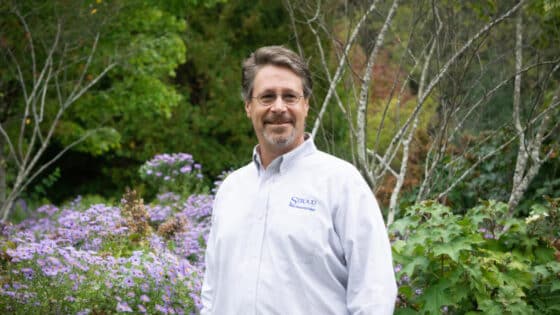
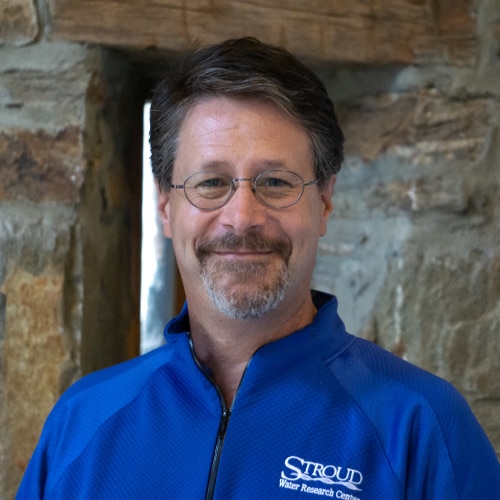
Executive Director, President
Administration and Finance Department
Research Scientist
Fish Ecology Group
Adjunct Professor, Department of Biology, University of Pennsylvania
Contact
darscott@stroudcenter.org
tel. 610-910-0046
970 Spencer Road, Avondale, PA 19311
Interests and Expertise
David Arscott’s research focuses on aquatic primary production, distribution and diversity of aquatic macroinvertebrates, ecohydrology, and the ecology of rivers and floodplains. His interests include riverine landscape ecology and dynamics, aquatic invertebrate, fish, and algal ecology, aquatic food web structure and dynamics, habitat conservation, and land-water interactions. Arscott’s research experiences in Michigan, New Hampshire, Alaska, Minnesota, New York, Italy, Switzerland, New Zealand, and Antarctica have provided him with a broad spectrum of experiences in aquatic habitats from the arctic tundra to the European and Southern Alps to Antarctica.
Google Scholar | Curriculum vitae
Education
- Ph.D., freshwater ecology, Swiss Federal Institute of Technology, Zurich, Switzerland, conducted at the Swiss Federal Institute of Environmental Science and Technology.
- M.S., water resources management, University of New Hampshire, Department of Natural Resources, Durham, New Hampshire.
- B.S., biology, chemistry, and conservation, Central Michigan University, Mt. Pleasant, Michigan.
Professional Experience
- President, executive director, research scientist, Stroud Water Research Center, 2017–present.
- Vice president, executive director, research scientist, Stroud Water Research Center, 2017.
- Vice president, assistant director, research scientist, Stroud Water Research Center, 2009–2016.
- Freshwater ecologist, National Institute for Water and Atmospheric Research, Christchurch, New Zealand, 2006–2009.
- Project coordinator/research scientist, Stroud Water Research Center, 2003–2006.
- Research assistant professor, University of Minnesota, Crookston, Center for Agriculture and Natural Resources, Crookston, Minnesota, 2002–2003.
- Student Conservation Association resource assistant intern, U.S. Forest Service, Fisheries and Wildlife Division, Ketchikan Rangers District, Alaska, 1994–1995.
Publications
See all publications by Stroud Center authors
Related News
UpStream Newsletter, June 2013
UpStream Newsletter, Fall 2012
UpStream Newsletter, Summer 2012
Gone Fishin’: Evaluating the Threat of Agricultural Contaminants in the Río Sierpe
Stroud Center Awarded Grant to Study Agricultural Contaminants
UpStream Newsletter, Winter 2011