Recent Floods Highlight Need for River Science

By Scott Ensign, Ph.D.
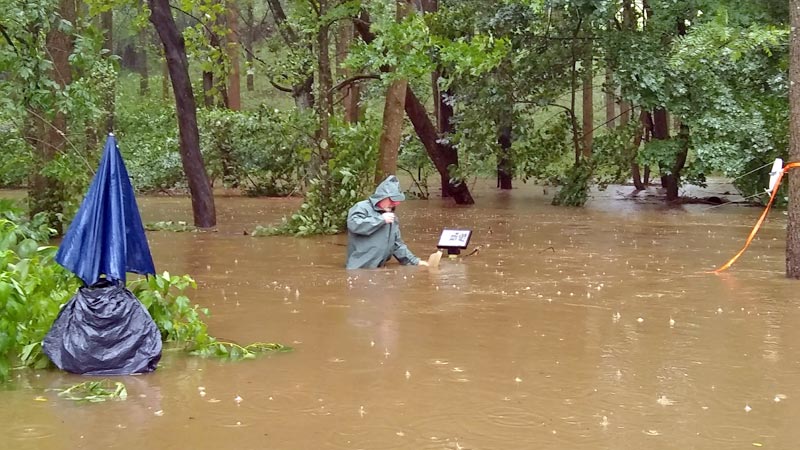
The recent flood-related deaths and damage in Texas and North Carolina are a tragic reminder of the importance of river monitoring. Yet federal funding that supports such monitoring is now at risk.
Federal funding priorities are shifting, and the Department of the Interior (DOI) has put forward a 2026 budget request that completely eliminates a key component of the U.S. Geological Survey: the Ecosystems Mission Area. It’s a surprising proposal, given USGS’s mission to “[provide] actionable science to decision makers about … water resources.” Water itself is a resource, and water resources — streams, rivers, and the ecosystems that they sustain — are too.
Such a significant cut to federal science, totaling 39% across the agency’s budget and 35% fewer staff, is a problem not just for the plants and animals that make up river ecosystems, but also for the water scientists like myself who study them, and every American — because we all rely on and live near a river or stream.
Valuable Water Data and Monitoring Are at Risk
USGS scientists have led key advancements in water science, from the development of modern hydrology in the 1960s to advanced modeling of rivers today. The strength of the agency comes from its long-term commitment to data collection and the integration of landscapes with rivers and their ecosystems.
Not only does USGS lead foundational studies, which Stroud Water Research Center and others build on, but it also collaborates directly with scientists at the Stroud Center. Just recently, Alan Gellis, Ph.D., of the Maryland-Delaware-D.C. Water Science Center worked with the Stroud Center’s Melinda Daniels, Ph.D., to examine sources of sediment pollution in streams. USGS also collaborates with partners to advance water monitoring technologies; I am working with Shannon Hicks and Sara Damiano here at the Stroud Center to build lower-cost flood monitoring equipment for the USGS’s Next Generation Water Observing System.

A mainstay of USGS is its 12,165 streamgages and integrated data network that give scientists and the public access to a treasure trove of information that enables disaster preparedness, flood warnings, climate adaptation, and wildlife protection.
DOI is requesting 22% less in 2026 for the program that runs this network. While the request expressly calls for funding to “maintain support for USGS streamgages,” the funding cuts to the Water Resources Mission Area threaten the maintenance and modernization of streamgages and their use in field operations. Though plans remain uncertain, dozens of Water Science Centers, which use USGS streamgages to monitor drought and flooding, have been threatened with closure, including in Pennsylvania and Delaware. Leaner staffing and tighter budgets degrade our country’s emergency readiness and capacity for scientific problem-solving.
River Monitoring Is a Health and Safety Issue, Not a “Social Agenda”
It is this network of long-term river monitoring, the USGS National Streamgaging Network, that has allowed scientists to detect the increasing occurrence of river heat waves caused by a warming planet. While DOI may mistakenly dismiss this research as serving a “social agenda,” accounting for these heat waves is paramount to assessing river health and mitigating hazards that threaten freshwater ecosystems.
River ecosystem science is more relevant now than ever. The threats to streams and rivers are increasing, solutions are frustratingly elusive, and some of the brightest minds in federal science are out of work. Therefore, the rest of us must double down on science to save rivers, as well as lives.
Double Down on Freshwater Science
Help us produce the trusted science needed for successful stream and river conservation: donate today.