How Science and Partnership Help Communities Understand and Protect Their Water

A Critical Moment for Implementation
Across the country, science standards increasingly emphasize investigation and real-world problem solving in an effort to increase environmental literacy. Yet for many schools, meaningful outdoor science experiences remain difficult to implement. They require coordination, funding, trained educators, and community partners.
At the same time, freshwater challenges are accelerating. Stormwater runoff and water pollution affect communities across watersheds. But through watershed science education, it’s possible to build the systems understanding that today’s standards demand and help students discover how their communities are connected through shared waters.
Forty-eight states and the District of Columbia have adopted the Next Generation Science Standards (NGSS) or similar standards, many incorporating Meaningful Watershed Educational Experiences (MWEEs). Yet standards alone do not ensure environmental literacy. Alignment across teachers, administrators, scientists, state agencies, and community partners is also needed. Without that connective infrastructure, implementation stalls. Stroud Water Research Center, through a robust environmental education program, works at that very crossroads.
Research as Foundation, Partnership as Strategy
With more than 50 years of research on streams and rivers, the Stroud Center brings scientific rigor to environmental education. Its education team translates science into watershed learning experiences for teachers, students, and communities. From watershed dynamics to stream ecology, these translations are grounded in peer-reviewed science and field-tested methodologies. The team brings students into the watershed to learn how water moves through landscapes, land use and climate affect streams, and evidence informs decisions.
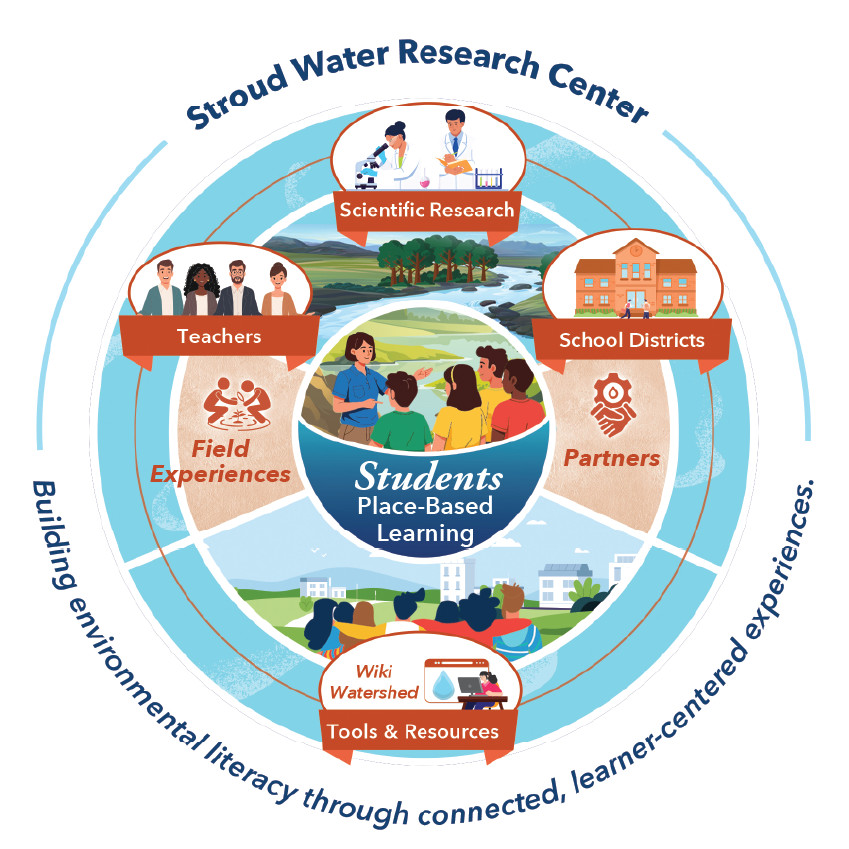
Rather than delivering only one-time teacher workshops, Stroud Center educators form multiyear partnerships that bridge the gap between research and understanding. Curricula are co-developed with schools and their teachers. Professional development unfolds over multiple sessions, with demonstrations, co-teaching, and iterative refinement. The goal is independent teacher leadership embedded within district systems.
“Co-developing something with a teacher is much better than just handing them something, because it’s really going to their students, their community, their curriculum, and that’s really critical,” says David Christopher, marine education specialist with Delaware Sea Grant, a Stroud Center partner on a NOAA B-WET grant. “The idea is that when teachers are implementing the curriculum, we’re there to support them.”
Place-Based, Learner-Centered Design
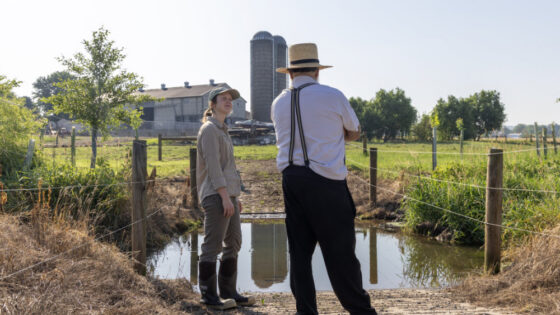
Because curricula are co-developed rather than prescribed, districts and educators deliver place-based education tailored to their students and communities — rural or urban, inland or coastal, affluent or economically disadvantaged. Instruction begins with students’ lived experiences and connects directly to local landscapes, helping students see how their own communities fit within larger watershed systems.
“A key part of our work is translating freshwater research into experiences that students can investigate themselves,” says Tara Muenz, interim director of education at the Stroud Center. “When students explore their own schoolyards, streams, and neighborhoods, they begin to see how the science of water connects directly to their communities.”
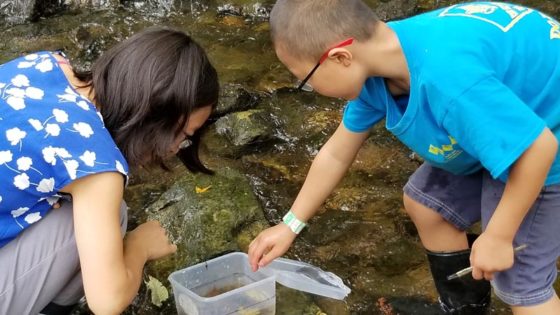
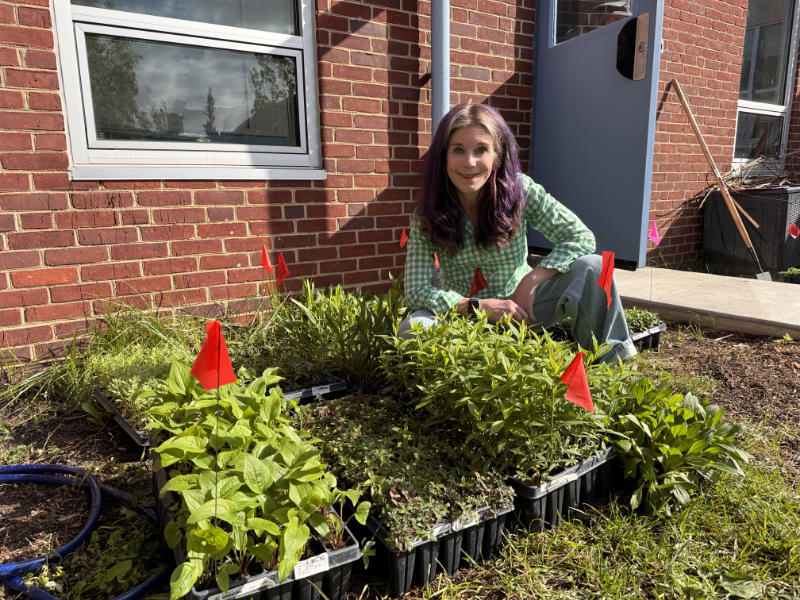
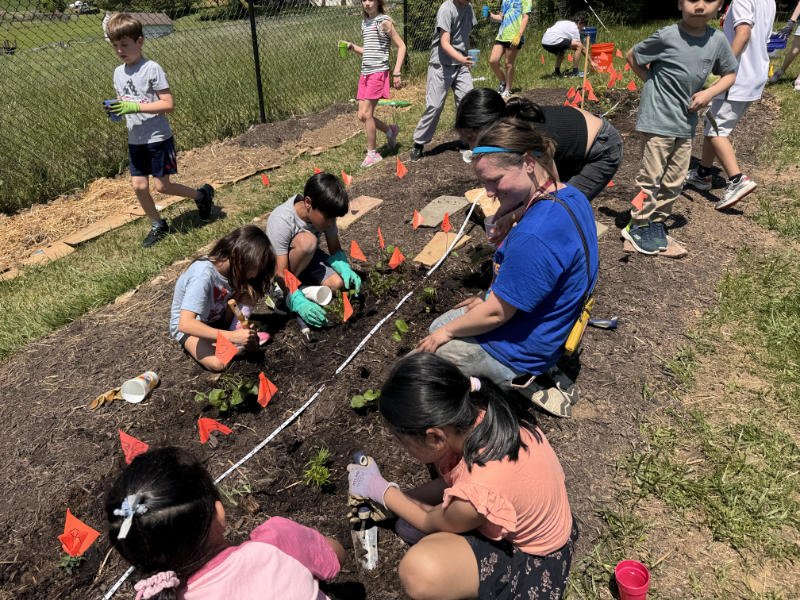
In some schools, students investigate stormwater runoff on asphalt- or turf-heavy campuses. In others, they examine agricultural drainage patterns or coastal watershed connections. Through the National Park Foundation Open Outdoors for Kids grant, students participate in learner-centered field experiences at the Stroud Center and at White Clay Creek State Park, expanding access to outdoor science learning.
This approach reflects the core of learner-centered education: lessons shaped around students’ needs, backgrounds, and community context while meeting NGSS standards. Place-based design strengthens engagement and supports long-term adoption at the district level.
Delaware: A Systems-Level Illustration
The Stroud Center’s education team works in multiple states and internationally, but Delaware illustrates the full partnership model that helps schools build both scientific understanding and community connections around shared water resources.
Since 2021, across four funded projects, the Stroud Center has empowered approximately 122 teachers in Delaware through sustained professional development, and those educators collectively reach an estimated 4,680 students. Among those teachers that completed surveys, 94% reported increased confidence teaching watershed science. By year three, approximately 92% will independently lead core lessons, demonstrating durable capacity building.
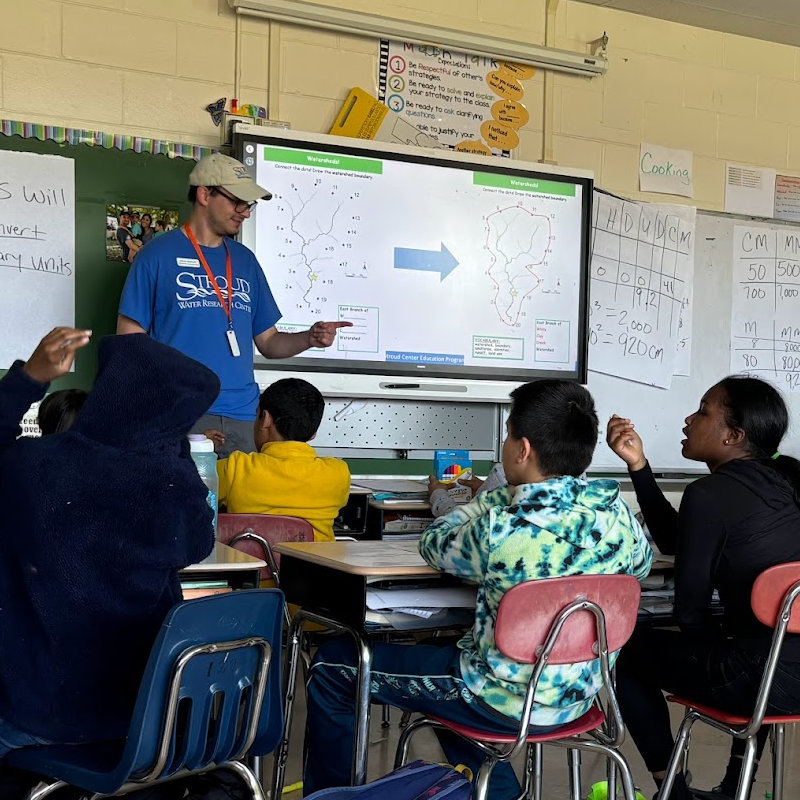
In the Red Clay Consolidated School District, engagement began with seven fifth-grade schools and has expanded to 12 across three consecutive years of partnership. Together with district leaders, the Stroud Center co-developed a three-lesson watershed unit aligned with NGSS and the MWEE framework.
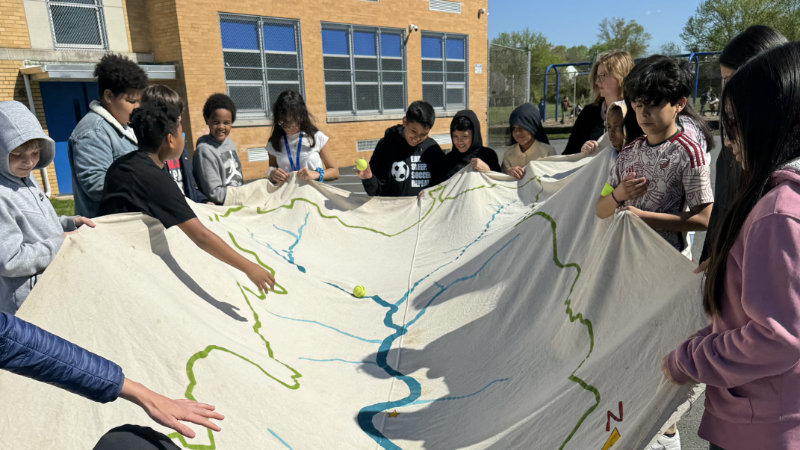
The first lesson introduces watershed function through a hands-on tapestry model and campus investigations. The second moves students into field research — rotating through watershed modeling, runoff and infiltration labs, and stream habitat studies using bilingual field notebooks.
“Students absolutely loved it both years,” one teacher shared. “The first year it was a little rainy and cold, but the kids didn’t complain, and they loved being immersed in the field and moonlighting as a scientist for a day!”
The third lesson returns students to their campuses to map runoff patterns and propose solutions. In one school, students selected and installed a rain chain to reduce erosion and pooling. The progression from classroom to field to action translates freshwater science into applied, community-rooted learning.
“Watching the growth of the teachers and students throughout these two years has been rewarding and reminds us that if we want our students to grow as responsible, Earth-minded citizens, then we must take the initiative and time to make these experiences and lessons available to our students. Our partnership with the educators at Stroud Water Research Center has made this possible.” — Sonia Saunders, Environmental Education Specialist, Red Clay Consolidated School District
Collaboration Is the Infrastructure of Understanding
Environmental literacy at scale cannot be built by a single institution. Understanding water requires people, communities, and institutions to work together.
Through a NOAA B-WET–funded partnership initiated in 2021 (with Stroud Center funding through 2026), the Stroud Center works alongside Delaware Sea Grant and the Delaware Nature Society to support teacher professional development, environmental literacy planning, and MWEE implementation across districts.
“These partnerships are the only way to move forward. There’s so much work to be done. I think the more people we have working together, the more we can advance environmental literacy in Delaware,” says Christopher.
The Stroud Center frequently serves as convener and connector — linking districts to field experiences, partners, and research tools such as WikiWatershed that support watershed education.
Scientific independence strengthens this role. As a nonadvocacy research institution, the Stroud Center builds trust across diverse stakeholders, enabling collaboration grounded in shared evidence rather than ideology.
Recognition reflects that collaborative impact. In 2025, the Delaware Association for Environmental Education honored the Stroud Center education team with its Exemplary Partnership Award for Excellence.
A Replicable Model at a Pivotal Moment
The partnership model integrates research, standards alignment, teacher capacity building, and cross-sector collaboration. It builds internal district expertise rather than temporary programming.
Demand continues to grow as word of mouth spreads, and with greater, longer-term support, the Stroud Center could serve more schools and increase the compounding return on investment.
By combining rigorous research with sustained collaboration, the Stroud Center strengthens educational systems while equipping communities to better understand both the freshwater resources that connect them and their shared responsibility to care for them.
Learn More
To learn how you can support environmental literacy infrastructure, email development@stroudcenter.org.
Stroud Water Research Center publishes content like this in its annual report to celebrate the impact we make each year, while recognizing that our work is unfinished. To protect clean fresh water — a basic human right — we rely on the support of people like you. Donate to support science today for water tomorrow.