From PFAS to Road Salt, Science Helps Us Discover What’s Lurking in Our Water and Find Solutions

At daybreak, the sun’s warmth gives rise to mist above cornstalks and a nearby stream that flows toward homes, schools, and businesses not far away. From farm fields to city streets, water connects us all — and so do the remnants of how we live on land.
The cleaning products, fertilizers, and other substances that make modern life easier (at least in some ways), don’t disappear after use. They run down our drains, roads, and landscapes and end up in our water. Certain chemicals and microorganisms are increasingly detected in fresh water. They are often invisible, poorly understood, and not yet fully regulated, but they may threaten human health and ecosystems. Scientists call them emerging contaminants.
To protect clean water and healthy streams, Stroud Water Research Center studies how freshwater systems work from headwaters to mouth and across entire watersheds. Scientists then explore how these systems respond to human actions, providing answers that guide communities toward stewardship.
Understanding PFAS
Among the emerging contaminants that the Stroud Center is investigating are per- and polyfluoroalkyl substances (PFAS). More commonly called forever chemicals, their stability makes them highly desirable for use in food packaging, water-repellent fabrics, and much more. Once released into the environment, however, they become stubborn contaminants. They stick around, and they don’t break down easily. Worse, they have been linked to adverse health effects, including certain cancers. In aquatic organisms, PFAS exposure can lead to stress, diminished growth and reproduction, and mortality.
Complicating matters is the ever-evolving regulation of PFAS. In November of 2025, the Environmental Protection Agency approved the use of two new pesticides that qualify as PFAS.
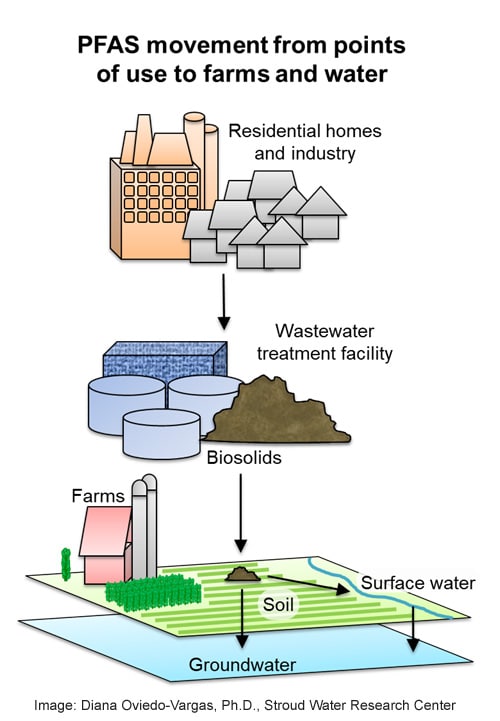
One known source of PFAS that’s gained widespread attention is biosolids, or sewage sludge — a human waste product used as fertilizer. It’s cheap and effective, but its agricultural use has led to questions about food and groundwater safety.
To understand the potential for biosolids to contaminate farm soils and nearby surface waters, the Stroud Center embarked on a study in collaboration with the Center for PFAS Solutions.
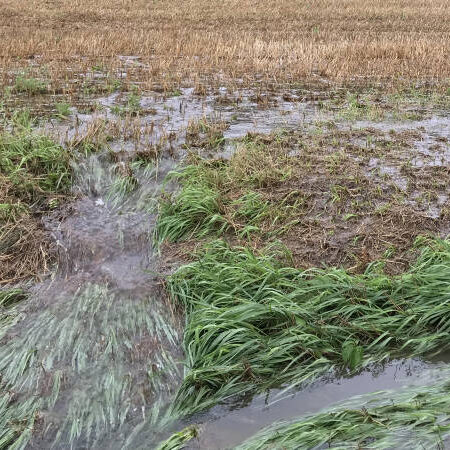
Comparing soil samples from treated and untreated fields on 10 U.S. farms, researchers found much higher concentrations of PFAS in the treated soils, indicating biosolids can be a significant source of PFAS contamination. They also found PFAS in nearby streams, raising concern for the freshwater ecosystems that surround farm fields and for anyone living downstream.
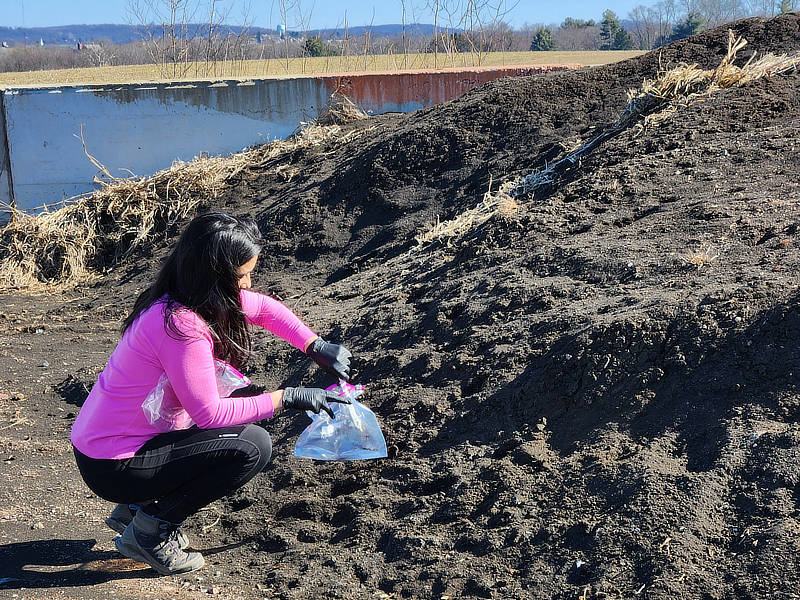
In a new study, the team is working to better understand when, how, and how much of these contaminants are transported from farm fields to streams.
Understanding Pesticides
Pesticides too can travel from farm to stream. Stroud Center studies have examined how the world’s most commonly used insecticides — neonicotinoids — impact water quality and stream health.
Starting in 2019, researchers collected stormwater runoff and stream samples from farms that used neonicotinoid-coated seeds. They found all the fields produced contaminated samples. One field stopped using the coated seeds at the start of the study; yet it still produced contaminated samples four years later, though concentrations slowly declined.
The study also examined the toxicity of neonicotinoids to aquatic life and confirmed what other research has shown: that exposure to neonicotinoids results in mayfly death.
Other Stroud Center research yet to be published indicates neonicotinoids lead to freshwater biofilms that are less diverse, suppressing the growth of sensitive species and interfering with essential microbial processes. Though more research is needed, these changes could in theory slow a stream’s ability to maintain water quality, regulate climate, and sustain the fish, insects, and tadpoles that feed on biofilms.
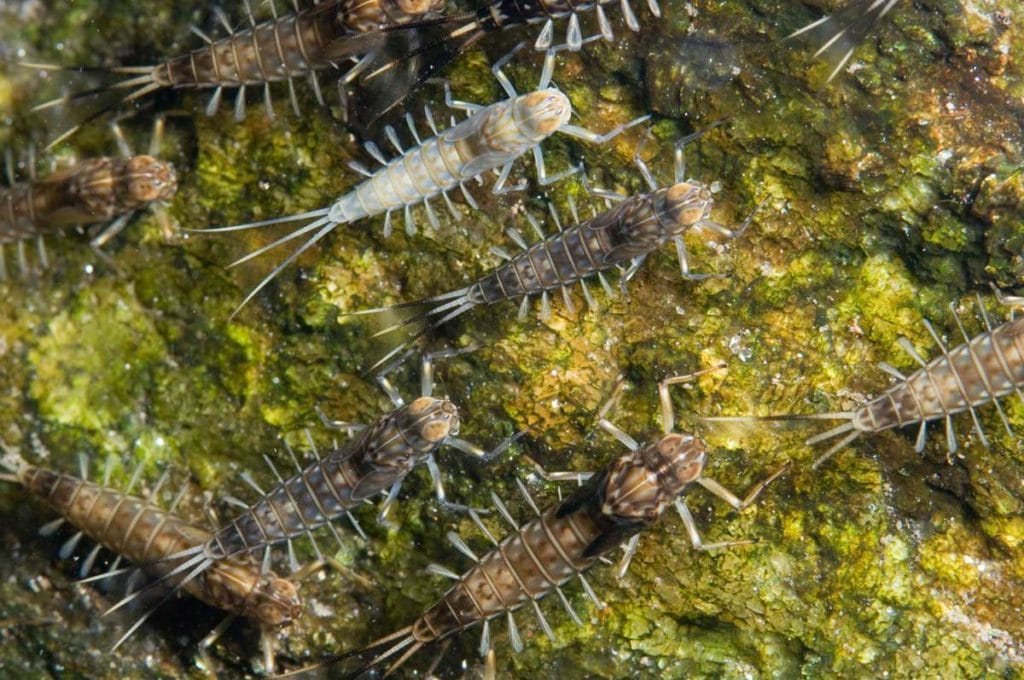
Together, these studies show how water-soluble pesticides move from soils to surface waters, where they can harm aquatic life. They also underscore a larger truth: emerging contaminants are rarely the result of one decision, but of many choices shared across society.
Understanding the Human Element
Contaminants become pervasive because despite their potential failings, they offer some benefit — often to society at large. Biosolids, for example, become contaminated because industry produces or uses PFAS, and humans consume PFAS-laden products. Those chemicals end up in wastewater. Treatment plants process it into biosolids, a material that must be managed, reused, or disposed of.
“There are no easy solutions, but research can help guide us,” Diana Oviedo Vargas, Ph.D., said about PFAS. She leads the Stroud Center’s biosolids research.
As an independent, nonadvocacy research institution, the Stroud Center’s role is to illuminate the pathways that connect human activity to freshwater ecosystems — not to assign blame, but to inform better decisions.
Turning Knowledge Into Action
With improved understanding of how contaminants impact fresh water, and of the human role in their emergence, comes shared responsibility — a torch that many have chosen to carry in response to another challenge: salt pollution.
The use of road salt has risen dramatically in recent decades, and so has the saltiness of freshwater streams, rivers, and groundwater. In 1940, the United States spread 164,000 U.S. tons of road salt each year, according to the U.S. Dept. of the Interior, Bureau of Mines. Today, U.S. Geological Survey data shows the country uses closer to 28 million tons — 171 times more per year.
Salt, measured in streams as chloride, is found in freshwater ecosystems naturally. In the Delaware River basin, natural chloride levels are in the range of 5 to 10 milligrams per liter. In excess, however, salt degrades drinking water, corrodes infrastructure, and threatens aquatic life.
To document the emergence of salt as a contaminant, identify patterns and hotspots, and empower people with the data and knowledge needed to tackle salt pollution in their communities, the Stroud Center launched a community science project.
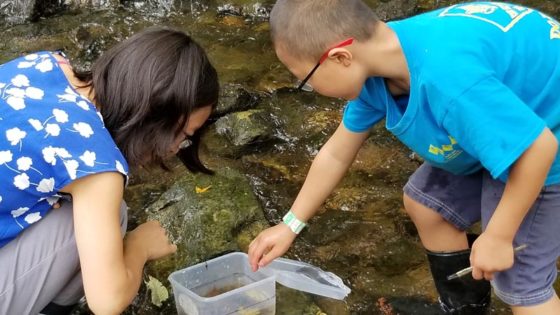
Kicking off with Winter Salt Week in January 2025, more than 700 people and 30 partners answered the Stroud Center’s call to measure the growing salt problem by wading into their local creeks and sampling about 600 sites in 18 states and five countries.

The Stroud Center provided guidance, tools, data analysis, and communications support, but it was the volunteers and the data they collected that showed how widespread and severe the problem has become, finding more than 70% of sampled stream sites exceeded one or more safe chloride concentration limits for aquatic life.
They also found something greater: community. Together, with help from the Stroud Center and its conservation partners, volunteers discovered an issue they could understand, a cause they could get behind, and collective actions they could take. Many chose to use the data they gathered and what they learned as a result to advocate for change, speaking with neighbors, HOAs, local businesses, and municipal and state leaders about wise salting practices.
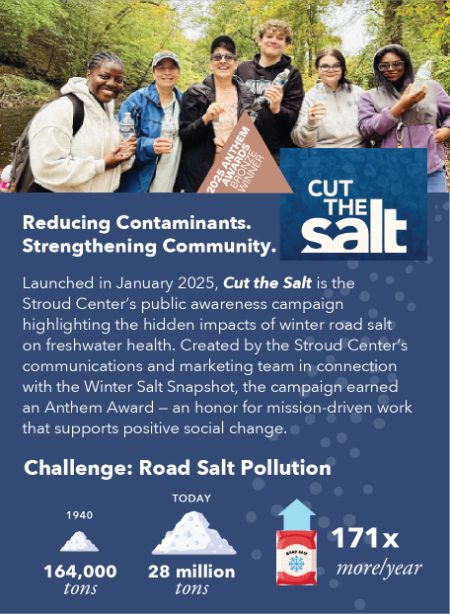
Building on that momentum, the Stroud Center asked its network to monitor streams for road salt contamination during another snapshot window in October 2025.
While the winter snapshot revealed elevated salt levels during winter conditions with active salting, the baseflow snapshot during the fall season showed the lingering impact of road salt long after winter salting had ended. Once again, community scientists stepped up — this time, in even greater force: nearly 100 partner organizations and their volunteers sampled more than 1,200 stream sites in the mid-Atlantic and beyond.
They found more than 700 locations, or 58% of sites, surpassed aquatic life thresholds. There were 61 hotspots, and 51 of them exceeded Pennsylvania’s drinking water standard for chloride.
Volunteers were energized. The majority of those who responded to a survey about the fall snapshot said their participation motivated them to share what they had learned with others.
“Road salt is not a ‘them’ problem. It’s our problem. All of us. We asked for it, and we paid for it. It’s been highly effective and reasonably inexpensive, but it‘s come at a cost,” said Senior Research Scientist John Jackson, Ph.D., who leads the Stroud Center’s salt pollution research. “The power of science is that it can show us not only what’s gone wrong in our fresh water but also how to fix it. We just have to work together.”
Stroud Water Research Center publishes content like this in its annual report to celebrate the impact we make each year, while recognizing that our work is unfinished. To protect clean fresh water — a basic human right — we rely on the support of people like you. Donate to support science today for water tomorrow.
About the Author
Diane Huskinson is the associate director of communications at Stroud Water Research Center, where she leads strategic storytelling that strengthens public understanding of freshwater science and builds support for protecting rivers and streams. She serves as the Stroud Center’s lead narrative voice, editor, and brand steward — shaping how the world sees and values the only independent, nonadvocacy research organization dedicated solely to freshwater ecosystems.